
September 14, 2026
Batteries Take Center Stage at the Great New York State Fair

The Great New York State Fair has long been known for agriculture, and it still is. But this year, more than 10,000 fairgoers who stopped by the NSF Energy Storage Engine in Upstate New York booth saw something more: robot arms, glowing lemons, a robot dog and a map of almost 300 organizations working on batteries here in New York.
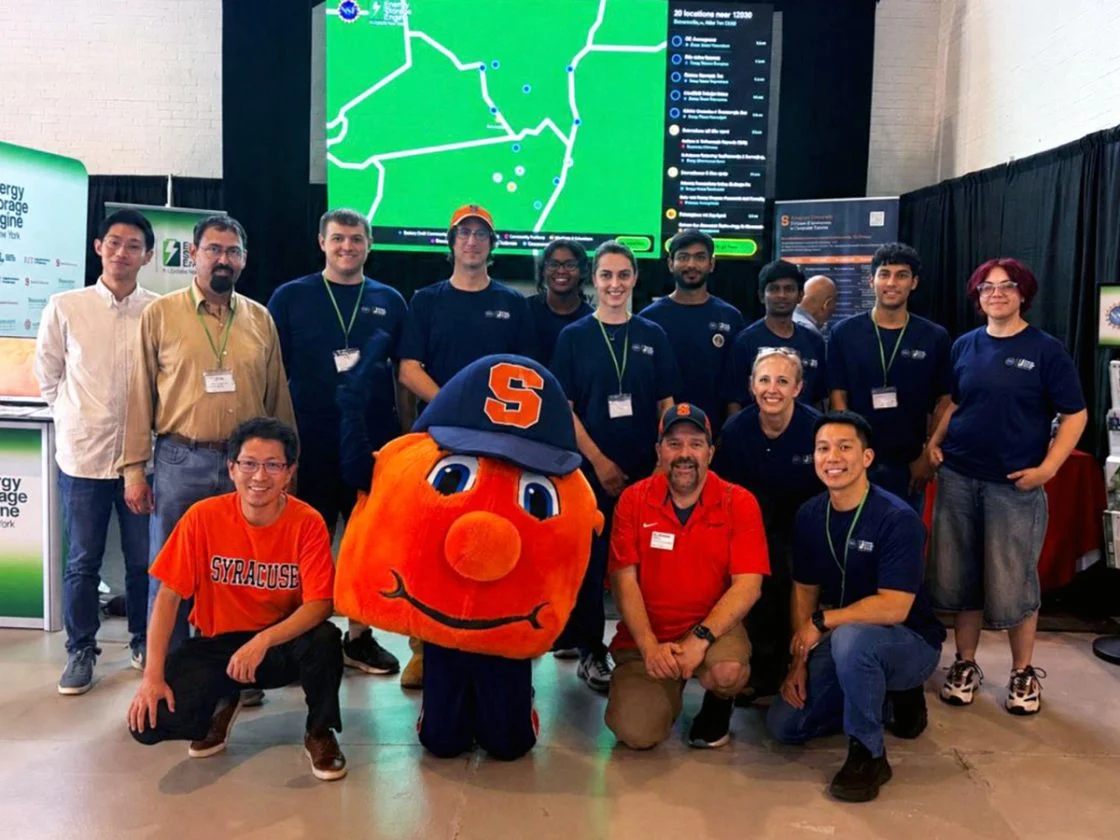
Over 13 days, more than 100 volunteers from six partner institutions took turns running the booth, each bringing hands-on demos, students, and a whole lot of energy.
What brought us to the Fair?
Our goals for the Fair were simple:
- Show New Yorkers that battery innovation is happening in their own backyard, from university labs to local companies.
- Make battery science hands-on and fun for visitors of every age.
- Spotlight our partner campuses and their students, the people doing this work every day.
- Help young people picture themselves in battery careers, and see that those jobs are growing across Upstate New York.
What fairgoers experienced
RIT: Robots that build batteries
Rochester Institute of Technology brought educational shadow boxes showing the many forms batteries take, from tiny coin cells to AA batteries to the flat pouch batteries inside your phone or laptop. A microscope let visitors peek inside a rechargeable AA battery to see the layers of electrodes rolled up inside. RIT also brought an automated robot arm that showed how batteries can be assembled with precision. Visitors watched the arm pick up an electrode, place it on a scale to confirm it matched the exact weight of every other electrode, and then add it to a new stack.
Griffiss Institute: The lemon battery
The Griffiss Institute brought a classic: the lemon battery. Push two different metals into a lemon and connect them with wire, and electrons flow from one metal to the other, with the juice completing the circuit. The catch? One lemon makes less than a volt, not enough to light an LED. So our young fairgoers linked lemons together and tried different arrangements until the light came on, the same idea engineers use to connect cells into battery packs.
“When a kid figures out that three lemons can do what one can’t, that’s real problem solving. We want young people to see that the next generation of batteries, and the careers that come with it, are being built right here in Upstate New York,” said Tim Thomas, Chief Workforce Officer, NSF Energy Storage Engine in Upstate New York.
Syracuse University: Robot dogs and boundless energy
Syracuse University showed up with a full crew of faculty and students, a robot dog, a VR headset, a remote-operated robot arm on wheels, and enthusiasm to spare. Otto the Orange even stopped by to take the robot dog for a walk and hand out plenty of hugs.
Binghamton University: Mapping New York’s battery ecosystem
Binghamton University put the spotlight on our interactive map, which shows almost 300 organizations working on batteries across New York State. Fairgoers tapped “learn more” on more than half of them to find out who is doing this work close to home.
Fairgoers also tested their battery knowledge with a timed, five-question quiz that mixed easy, medium, and hard questions to keep everyone on their toes. Most players scored between 4,000 and 7,000 points, and some came back day after day to see if they could beat their own score!
Cornell University: Focus on our littlest scientists
Cornell University focused on the youngest visitors, with coloring pages designed to introduce budding scientists to the basics of batteries. Along the way, kids learned just how many things in their everyday lives run on batteries and parents enjoyed competing in the battery trivia game.
Alfred University: Real solutions, built for the Fair

Alfred University students also built demos specifically for the Fair. One student developed a working model of a real battery manufacturing system: a small conveyor belt with a small camera and a simple AI program that checks whether each battery is facing in the right direction. If a battery is backwards, the belt stops so it can be flipped. The model was based on a solution an Alfred professor developed for an industry partner that was successfully deployed in the company’s manufacturing line.
Another student built a complete mini grid, with a circuit board replicating a power grid, a battery, lights, a fan, and small panels powered by bright lamps. It was a simple way to show how energy systems work, how backup power works, and why it helps to have more than one power source. It sparked great conversations about peak energy times, stress on the grid, and where AI data centers and energy storage innovation fit into the picture.
The moments we didn’t plan for
A rainout turned into a rivalry. When thunderstorms flooded the fairgrounds and shut the Fair down for a day, our student volunteers from partner campuses used the downtime to take on the quiz themselves. Binghamton University student Aishani Misra, who studies Financial Economics and Mathematics, edged out Alfred University students with the Fair’s top score of 9,630!
A job lead, right at the booth. The Alfred University student who built and showcased the conveyor belt model was approached by a potential employer. It is connections like these that the Engine’s workforce development programs are promoting, and this one happened at a State Fair booth!
What we accomplished
People didn’t just walk past our booth. They stopped, played, and explored.
- More than 10,000 fairgoers stopped by the booth
- More than 2,000 fairgoers took the time to do our 5 question battery quiz
- 60 hours of hands-on use at our kiosk, meaning it was in use during 48 percent of the 125 hours the Fair was open
- 169 of the almost 300 organizations on the map were selected by fairgoers who wanted to learn more
- Six partner institutions, with more than 100 faculty, staff, and students brought battery science to the public
- One student left the Fair with a lead from a potential employer
Two years ago, Engine CEO Meera Sampath, Chief Executive Officer, NSF Energy Storage Engine in Upstate New York, shared her vision that the Great New York State Fair would eventually become known for our battery industry as much as it is known for agriculture today. This year, we heard it from our partners: “The Fair has become a showcase for New York’s growing battery industry and we’re proud to be in such good company,” said Viridi, a Buffalo based battery company.
“Watching the families and students get hands-on with batteries and robots batteries, vie for the prize at the end of the battery quiz, and the curiosity of many to learn more about the battery organizations in NY and last but not the least, it’s the enthusiasm and energy of our volunteers, it is clear that vision is beginning to be realized,” said Maggie Cousin, Strategic Communication lead of the Engine and “architect-in-chief” for the booth.
Thank you
Thank you to Rochester Institute of Technology, the Griffiss Institute, Syracuse University, Binghamton University, Cornell University, Alfred University, Viridi, and every student, faculty member, and staff volunteer who gave their time to spark curiosity about batteries. See you at the Fair next year!
Advancing batteries, energizing New York communities.
Other Press
NSF Energy Storage Engine Returns to State Fair
Robots, Robot Dogs and Batteries Draw a Crowd at the New York State Fair
Alfred University Team Showcases Battery Artificial Intelligence at the New York State Fair
Contact
Maggie Cousin
Strategic Communications Lead
NSF Energy Storage Engine in Upstate NY
mcousin@binghamton.edu
