
September 28, 2026
The Boat, the Charger and the Floating Battery: Photon Marine Receives $1 Million Inaugural MegaBoost Award
What the Energy Storage Engine’s First MegaBoost Award Will Build
The NSF Energy Storage Engine in Upstate New York has awarded its first $1 million MegaBoost to Photon Marine, which will put a production-grade electric workboat, a marine fast charger and a first-of-its-kind floating energy storage platform into service in New York State.
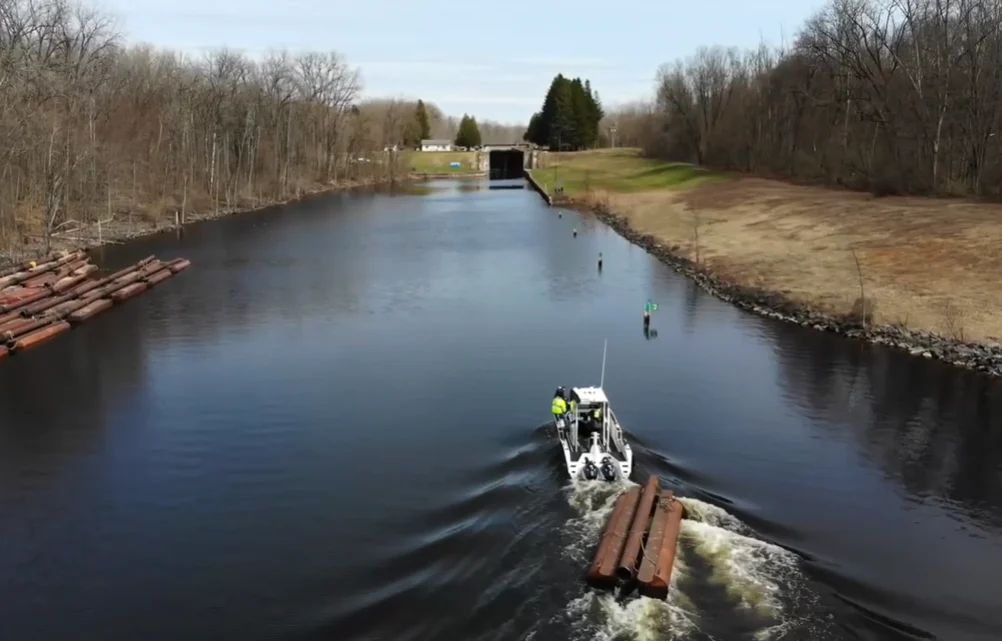
For several seasons, a small workboat has been quietly doing ordinary things on the New York State Canal System. Pulling buoys. Towing dredge pipe. Hauling crews out to job sites. Clearing debris after a storm.
What made it unusual is what it did not do: burn fuel.
That boat, a leased hull fitted with electric outboards from Photon Marine, was a pilot project with the New York Power Authority and the New York State Canal Corporation. The crews wanted to know something practical. Not whether an electric workboat could exist, but whether it could get through a Tuesday.
The answer was encouraging enough that the next chapter is considerably more ambitious.
The NSF Energy Storage Engine in Upstate New York has selected Photon Marine to receive its inaugural $1 million MegaBoost award. Building on the real-world operating experience from that pilot, the company will develop something American waterways have not yet had: a complete marine electrification ecosystem, with the boat, the charger and the energy storage all designed to work together.
Three pieces, one system
The first piece is the vessel. A 24-foot workboat equipped with Photon Marine’s Gen-7 P300 electric propulsion system, which delivers up to 300 peak horsepower. Unlike the leased test boat that came before it, this one is production-grade, meaning it is built to the standard a fleet manager could actually order.
The second piece is a 40-kilowatt marine DC fast charger, designed to support commercial, government and recreational vessels using New York’s waterways. This sounds mundane. It is arguably the most important part of the project. A boat without a charger is a boat with a deadline.
The third piece is the one that has no real precedent. It is called the ChargeBarge: a 32-foot floating platform carrying battery energy storage and high-power charging equipment. Instead of requiring every dock and lock and boat launch to be wired for fast charging, the ChargeBarge moves the energy to wherever the work is happening.
Think of it as a power station that can untie itself and go. It is designed to charge vessels directly, support fleets working far from shore power, serve temporary events, and potentially supply power during grid disruptions. It will be fabricated in New York State by Derecktor Shipyards.
“Commercial marine electrification will only scale when operators can see that the technology works in the conditions they face every day,” said Marcelino J. Alvarez, Co-founder and CEO of Photon Marine. “This project gives us the opportunity to demonstrate an entire electrification ecosystem, from the propulsion system to the charger to mobile energy storage, while building on the real-world operating experience we have developed with NYPA. Just as importantly, we are doing it on one of America’s most iconic waterways and working with New York partners to create a model that can ultimately be replicated far beyond the Erie Canal, from international sailing races to Caribbean fishing fleets to dual-use and autonomous applications”

Canal crews used the electric test vessel for everyday tasks including buoy retrieval, dredge pipe towing and crew transport.
Why workboats have been the hard part
Passenger cars went electric first for a reason. A car has a driveway. A workboat has a duty cycle.
Commercial and government vessels operate in ports, canals and harbors across the country, doing maintenance, environmental monitoring, harbor work and public safety. Those jobs demand high power on demand, equipment that tolerates rough handling, and a way to recharge in places that were never wired for it. Waterfronts, unlike highways, have no charging network waiting.
Photon Marine’s approach is to stop waiting for one. By pairing a production propulsion system with both fixed and mobile charging, a fleet can electrify part of its operation now rather than after a decade of infrastructure buildout.
The project is expected to produce something the industry currently lacks: a real operational record. Vessel performance, battery state of charge and health, charging utilization, duty-cycle requirements, vessel-to-vessel energy transfer and potential grid applications. Photon Marine will also develop a fleet-electrification playbook so other operators can evaluate the same move without starting from zero.

Photon Marine’s Gen-7 P300 electric propulsion system delivers up to 300 peak horsepower.
A different kind of investment
MegaBoost marks a shift in how the Engine backs companies.
“This is an important moment for the NSF Energy Storage Engine because MegaBoost takes our commercialization model to an entirely different level,” said Meera Sampath, Ph.D., CEO of the NSF Energy Storage Engine in Upstate New York. “It’s about market-making: moving beyond supporting individual technologies and helping companies demonstrate complete systems, with customers, infrastructure and a path to commercial scale. Photon Marine is exactly the kind of ambitious, customer-driven project we want to bring to Upstate New York as we build the market for new energy storage technologies here”
Through SuperBoost, the Engine has helped emerging companies clear technical and scale-up hurdles. MegaBoost is built for the step after that: larger, customer-driven demonstrations at commercially relevant scale.
“MegaBoost is about closing the gap between a technology that works and a product or system that customers will actually deploy at scale,” said Fernando Gómez-Baquero, Director of Translation for the NSF Energy Storage Engine in Upstate New York. “Photon Marine brings together several pieces that are usually addressed separately: the vessel, the propulsion system, energy storage, charging infrastructure and real-world operating experience. That integration is what makes this such a compelling first MegaBoost award.”
Built in New York, run on the canal

The Erie Canal, which opened in 1825, remains an active working waterway maintained by the New York State Canal Corporation.
The ChargeBarge will be fabricated in New York State by Derecktor Shipyards. The project will draw on regional energy storage and commercialization resources, and it will support skilled manufacturing and marine-industry work along the way.
“We have been very intentional about building an NSF Engine that does more than fund research,” Sampath added. “Our goal is to create the conditions in which technologies are developed, tested, manufactured and bought here. MegaBoost gives us another powerful tool to make that happen and to reinforce Upstate New York’s position as America’s battery and energy storage tech capital.”
The Photon Marine MegaBoost project is expected to culminate in late 2027 or early 2028 with a fully integrated demonstration of the electric workboat, marine charging infrastructure and ChargeBarge, alongside a roadmap for expanding marine electrification across New York State waterways and other U.S. commercial fleets.
The canal system opened in 1825. Two centuries on, the work it takes to keep a waterway running is still the best test there is.

An electric workboat powered by Photon Marine outboards docked on the Erie Canal.
In their words
About Photon Marine
Photon Marine is a U.S.-based marine technology company developing high-performance electric propulsion systems and supporting infrastructure for commercial and recreational vessels. The company’s technology platform is designed to enable reliable, production-scale marine electrification across a range of vessel types and operating environments.
For more information, visit photonmarine.com.
Contact:
Marcelino J. Alvarez
Co-founder & CEO
Photon Marine
marcelino@photonmarine.com
About the NSF Energy Storage Engine in Upstate New York
The NSF Energy Storage Engine in Upstate New York, led by Binghamton University, is a National Science Foundation-funded, place-based innovation program. The coalition includes over 60 academic, industry, nonprofit, government and community partners across Upstate New York, including Cornell University, Rochester Institute of Technology, Griffiss Institute, Syracuse University, Launch NY and NY-BEST.
The Engine works across research and development, technology translation and commercialization, workforce development, and test beds and infrastructure to accelerate the next generation of energy storage technologies and strengthen U.S. energy independence, economic competitiveness and national security.
Its mission is to establish Upstate New York as America’s battery technology capital, creating an internationally competitive ecosystem capable of developing, manufacturing and deploying energy storage technologies in the United States.
Contact:
Fernando Gómez-Baquero, Ph.D.
Director of Translation
NSF Energy Storage Engine in Upstate New York
fernando@cornell.edu
Select Media Coverage
